
Our Work: Programs
Motive designs and implements a variety of programs for government, industry, and civil society sector partners. Whether we’re implementing complex projects overseas or providing advisory services right here in the U.S., 100% of Motive’s programs are aligned with our mission to mitigate conflict and promote stability around the globe.

Motive International hosted strategists, practitioners, software engineers, and researchers at the University of Mississippi's National Center for Narrative Intelligence for a Narrative Constructs in Joint Operations working group, a collaborative forum focused on examining the role of narrative as a strategic tool in modern military and information operations.


In 2021-22, Motive International was subcontracted by a large business prime contract holder to design and build an Atrocity Prevention (AP) tabletop exercise (TTX) for the U.S. State Department’s Bureau of Democracy, Human Rights and Labor (State/DRL). Delivered to State/DRL in September 2022, the TTX Motive developed today serves as the primary mechanism to fulfill the State Department’s Congressional mandate to train U.S. officials in AP as per the Eli Wiesel Genocide and Atrocities Prevention Act of 2018. Through immersive learning that measurably translates to real-world AP impacts, this project demonstrates Motive’s mastery harnessing the power of TTXs to advance our mission to mitigate conflict and bolster global stability.


In September 2022, the U.S. government’s Institute for Security Governance (ISG) hosted the week-long Panama Workshop at which Motive’s Ana Velsco served as an expert WPS facilitator. Designed to advance shared U.S.-Panama WPS goals, event participants included more than two dozen uniformed and civilian, male and female officials from different branches of Panama’s security agencies. Co-facilitators included officials from the U.S. Department of Defense (DoD) and academia.
Instead of informing Panamanian officials about the goals or principles of UNSCR 1325, co-facilitators sought to explore complex themes of gender and security through various framing questions. Why should a patrol officer guarding the Darien Gap think about gender? What use does a UN framework have for a police officer in the city of Colon? Is the WPS agenda -- often couched in the context of inter-state war -- even relevant for Latin America? As opposed to lecture-based approaches that can reduce gender and security to mere abstractions, the ensuing dialogue made WPS relevant, relatable, and durable.

Motive Subject Matter Expert Nathan Toronto shares how his recent experience advising the 3rd Security Force Assistance Brigade (3rd SFAB) and reflecting on “how the United States can reform military advising efforts to have a strategic effect, rather than achieving short-term tactical or operational gains that do not bear up under the weight of the overarching political conflict,” prompted him to consider the question “How does the Army know when an advisor is ready to deploy?”

This January and February, the 4th Security Force Assistance Brigade (SFAB) gave Motive the opportunity to build critical understanding among their personnel when they contracted us to provide embassy role players for their validation exercise ahead of a deployment to the European theatre. By the end of the two-week event, Motive earned widespread praise from the most senior and junior members of the training audience, including an SFAB team lead about to deploy for the first time who said, “I feel as though I could walk into any embassy in the world and do my job effectively because of what I learned.”

In May 2017, Motive CEO Morgan Keay was a featured panelist at the Center for Strategic and International Studies (CSIS) at an event entitled “The Role of Multi-Sector Partnerships in the New Development Era.” CSIS hosted this half-day event at the start of the Trump Administration when U.S. foreign assistance budgets faced significant cuts. The panel Morgan spoke on was asked to explore creative options to better leverage capital – financial or otherwise – through cross-sector partnerships, specifically in conflict-affected and fragile states.
Opening her remarks with the statement, “Conflict affects all sectors of society and therefore takes all sectors of society to address." Morgan confronted an idea considered to be heretical by many in the international development and diplomacy communities: expanded partnerships with the military can advance development and humanitarian goals. To make the case, Morgan offered a story about a real-world case study: a World Bank-funded road construction project through the heart of extremist-affected territory in West Africa’s Lake Chad Basin. This example illustrates what happened when local civil society, the host country’s military, and the U.S. military came together around a violence-plagued infrastructure project to transform human security in the region.

On 18-21 DEC 2018, Motive International's SME on Border Management Robert Colbert participated in a CENTCOM requested "Exploratory Workshop on Best Practices in Interagency Cooperation for Effective Border Management" in Dushanbe, Tajikistan. The purpose of this workshop was to gain insights into the Tajik Border Security capabilities by engaging members of the Tajik MoD and MoI involved in the Border Security mission, as well as representatives of the Border Guards, in a strategic listening opportunity prior to a CENTCOM led scoping visit on capacity building with the intent to provide training and equipment to the National Security forces of Tajikistan authorized under U.S. Code Title 10 § 333.

On 1-2 OCT 2019, the CENTCOM J3 Counternarcotics (CN) division -- in partnership with NESA -- sponsored a seminar and workshop called “Cracking the Code on Assessments, Monitoring & Evaluation (AM&E)” led by Motive International SMEs Ms. Morgan Keay and Dr. Salamah Magnuson. With participants from across CENTCOM, SOCOM, SOCCENT and from OSD/Counternarcotics, the event cultivated participants’ AM&E skills in the Theory of Change and Types & Targets of Change (T2Delta) methods, then facilitated the application of these methods to the CENTCOM CN portfolio.

In April and May of 2019, a team of Motive International experts composed of Dr. Salamah Magnuson, Morgan Keay and Kimberly Metcalf conducted an investigation of societal dynamics in Estonia through in-country field research focused on social cohesion and national security. The purpose of this initiative was to apply Motive’s Social Contract Assessment Tool (SCAT), a framework designed to identify and characterize social institutions and the sources of legitimacy that underpin them in transitioning or threatened societies in order to inform policies, plans and activities to mitigate threats and promote stability.
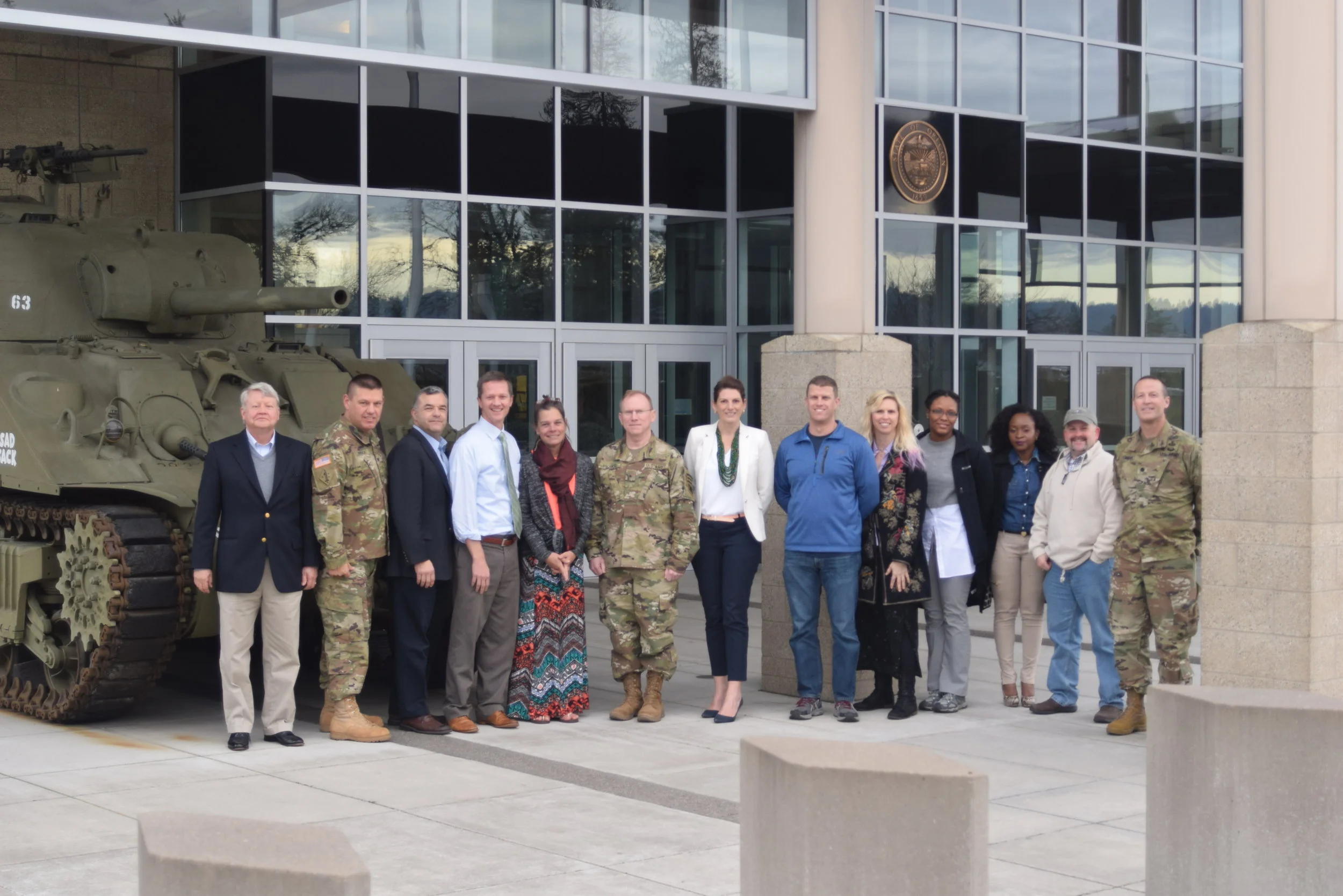
Client: 351st Civil Affairs Command/364th CA BDE
Helping cultivate readiness for U.S. Army Civil Affairs personnel to synchronize with interagency and inter-organizational partners in the context of stability operations, Motive provided an expert in diplomacy and humanitarian affairs to role play a UN Country Representative and to deliver instructional input for a 5-day, 200-person Command Post Exercise (CPX) at Camp Withycombe, Oregon in February 2017.
The PHL SIMEX validated that the Philippine Government's new FDI screening regime and policy position are sufficient to block high-stakes investments, such as the Chinese transaction in the national power grid. The exercise also highlighted key challenges, revealing that the IIPCC needs to improve interagency coordination, streamline bureaucratic procedures, and build capacity in mitigation strategy and negotiation tactics.